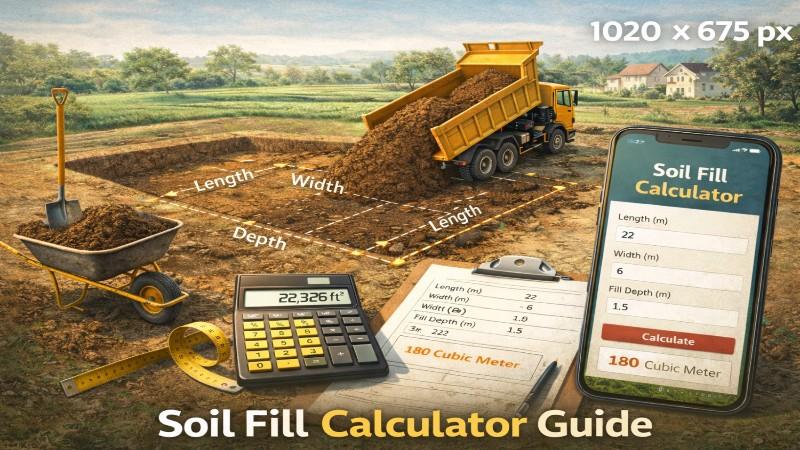
Soil Fill Calculator for Plot Leveling: Complete Guide to Calculate Soil Volume Accurately
soil fill calculatorplot levelingsoil volume calculatorearth filling calculatorcut and fill calculatorsoil estimation
Quick Summary: Soil Fill Calculation Essentials
Basic Formula: Soil Volume = Length × Width × Depth. Key Factor: Always add 15-25% for soil compaction. Solution: Use our professional soil fill calculator to avoid costly estimation errors in your construction projects.
Accurate soil volume calculation is essential for successful plot leveling and construction projects
Plot leveling is one of the most important steps before any construction, landscaping, or land development project. Whether you are preparing land for a house, road, boundary wall, or agricultural use, estimating the correct amount of soil required for plot leveling is critical. A small mistake in calculation can result in extra cost, delays, or uneven land.
This is where a soil fill calculator for plot leveling becomes extremely useful. In this guide, you'll learn how to calculate soil fill volume, understand the formulas, consider compaction factors, and use a soil volume calculator to get accurate results.
Use Our Professional Soil Fill Calculator
Get instant, accurate soil volume calculations for your plot leveling projects with our advanced calculator:
A soil fill calculator is a digital tool that helps you calculate the quantity of soil required to fill or level a plot of land. It uses basic dimensions such as length, width, and depth of fill to determine soil volume in cubic units.
Plot Leveling
Prepare land for construction
Earth Filling
Fill depressions and low areas
Land Grading
Create proper slopes and grades
Construction Prep
Prepare sites for buildings
Instead of manual calculations, a soil fill estimation calculator gives instant and accurate results, saving time and preventing costly errors.
Why Plot Leveling Is Necessary Before Construction
Plot leveling ensures a uniform ground surface, which is essential for:
Proper load distribution for foundations
Effective drainage to prevent water logging
Structural safety and stability
Compliance with building plans and regulations
Consequences of Uneven Land
Uneven land can cause foundation cracks, water logging, increased construction costs, and structural instability. That's why calculating soil required for plot leveling accurately is essential before starting any project.
Why You Need a Soil Fill Calculator for Plot Leveling
Manual soil calculation often leads to errors because:
Plots are irregular in shape
Depth varies across the plot
Soil compaction is ignored
Unit conversion mistakes occur
A plot leveling soil calculator helps you:
Calculate soil volume precisely
Avoid over-ordering or under-ordering soil
Save money on transportation and labor
Plan earthwork efficiently
Accurate Soil Volume Calculation Made Easy
Stop guessing and start calculating accurately with our professional soil fill calculator:
Example: If required soil volume = 300 m³ and compaction factor = 20%
Final soil required = 300 × 1.2 = 360 m³
A good soil fill calculator automatically considers compaction factors for accurate results.
Soil Types and Their Impact on Fill Calculation
Different soil types behave differently during filling and compaction:
Soil Type
Compaction Behavior
Best For
Sandy Soil
Low shrinkage, drains well
Foundation filling
Clay Soil
High shrinkage, retains water
Agricultural leveling
Loamy Soil
Medium shrinkage, balanced
General construction
Mixed Soil
High variation, unpredictable
Requires professional assessment
A proper earth filling calculator allows adjustment based on soil type for accurate estimation.
Plot Leveling for Raised Land (Low-Lying Plots)
Many plots are below road level and need filling. Here's the process:
Measure existing ground level
Decide final required level
Calculate height difference
Use calculate soil needed for raised plot formula
Example: Low-Lying Plot Calculation
Existing level: 0.5 m below road
Construction Prep
Prepare sites for buildings
Instead of manual calculations, a soil fill estimation calculator gives instant and accurate results, saving time and preventing costly errors.
Why Plot Leveling Is Necessary Before Construction
Plot leveling ensures a uniform ground surface, which is essential for:
Proper load distribution for foundations
Effective drainage to prevent water logging
Structural safety and stability
Compliance with building plans and regulations
Consequences of Uneven Land
Uneven land can cause foundation cracks, water logging, increased construction costs, and structural instability. That's why calculating soil required for plot leveling accurately is essential before starting any project.
Why You Need a Soil Fill Calculator for Plot Leveling
Manual soil calculation often leads to errors because:
Plots are irregular in shape
Depth varies across the plot
Soil compaction is ignored
Unit conversion mistakes occur
A plot leveling soil calculator helps you:
Calculate soil volume precisely
Avoid over-ordering or under-ordering soil
Save money on transportation and labor
Plan earthwork efficiently
Accurate Soil Volume Calculation Made Easy
Stop guessing and start calculating accurately with our professional soil fill calculator:
Proper soil volume calculation ensures efficient construction site preparation and cost control
FAQs: Soil Fill Calculator & Plot Leveling
A: Measure plot area, decide fill depth, apply compaction factor, and use a soil fill calculator for accurate results. The basic formula is Length × Width × Depth, but compaction can add 15-25% more soil.
A: The basic soil volume formula is Length × Width × Depth. For accurate estimation including compaction: Required Soil = Calculated Volume × (1 + Compaction Factor). Compaction factor ranges from 10% for loose soil to 25% for mixed soil.
A: Yes, ignoring compaction can cause 15-25% soil shortage. When loose soil is compacted, its volume reduces significantly. Sandy soil needs 15% extra, clay soil needs 20% extra, and mixed soil may need 25% extra to account for compaction.
A: It depends on plot size, depth, and soil type. For example, a 30m × 20m plot with 0.5m depth needs 300 cubic meters of soil before compaction. With 20% compaction factor, you'll need 360 cubic meters. Use our soil fill calculator for precise calculations.
A: Yes, but it's error-prone for irregular plots and when considering compaction factors. A digital soil fill calculator is recommended for accurate results, especially for construction projects where mistakes can be costly.
A: Cost = Soil Volume × Rate per unit. For example, 360 m³ soil at ₹500 per m³ = ₹1,80,000. Rates vary by location, soil type, and transportation distance. Our soil fill calculator can help estimate both volume and cost.
A: In regional construction terms, 1 brass equals 100 cubic feet. For a 1000 square feet plot with a 3-foot depth, the loose volume is 3000 cubic feet or 30 brass, which increases to around 36 brass after applying a standard 20% soil compaction factor.
A: To calculate soil volume for an irregular plot, divide the area into smaller regular triangles and rectangles, calculate the area of each sub-section, sum them up, multiply by the average filling depth, and add a 15-20% compaction allowance.
A: No, black cotton soil is highly expansive and swells when wet and shrinks when dry, making it unsuitable for plot leveling and foundation backfilling. You should use murrum or granular red soil instead.
A: Murrum soil has a compaction factor of approximately 15% to 20%. When calculating murrum volume, multiply the raw excavation volume by 1.20 to ensure you order enough material to achieve the desired compacted grade.
A: Set up the dumpy level at a central point, take staff readings at various corners of the plot, determine the elevation differences from your benchmark, and calculate the average height difference to find the average soil filling depth.
A: When leveling a sloping residential plot, you must calculate the wedge volume (0.5 × length × width × difference in height). Add this wedge volume to the flat volume, and apply a 15% to 25% compaction adjustment.
A: Bank volume is the soil in its natural, undisturbed state. Loose volume is the expanded soil volume after excavation and transport (typically 10-30% larger). Compacted volume is the final volume after rolling and compacting on site (smaller than loose volume).
A: A standard dumper truck carries about 200 to 300 cubic feet of soil (2 to 3 brass). If your plot requires 3600 cubic feet of compacted soil, you will need approximately 12 to 18 truckloads depending on the truck size.
A: Sand filling is preferred directly under the foundation slab and plinth because it drains water efficiently and is easier to compact uniformly compared to clayey soil, which can retain moisture and settle unevenly.
A: Loose filled soil can take 1 to 2 years to settle naturally under rain and gravity. To avoid waiting, professional construction projects use mechanical roller compactors in 150mm to 200mm layers (lifts) to achieve instant consolidation.
A: Civil contractors typically use cubic meters (m³), cubic feet (cft), brass (100 cft), or tractor/dumper truckloads. Our soil fill calculator lets you switch seamlessly between these units.
A: The average dry density of soil is about 100 to 110 lbs per cubic foot (approx. 1.6 tons per cubic meter). To convert cubic feet to tons, multiply the volume by 0.05 (e.g., 1000 cubic feet of soil weighs approximately 50 tons).
A: Yes, a retaining wall holds the filled soil in place, ensuring a vertical edge rather than a sloped slope. This reduces the total soil volume needed to fill the edges of the plot compared to letting the soil slope naturally.
A: Earth compaction rates vary by equipment and depth, but typically cost between ₹5 to ₹12 per square foot. This includes leveling the soil with a backhoe loader (JCB) and compacting it with a plate compactor or roller.
Best Practices for Plot Leveling
Measure dimensions accurately using proper surveying tools
Use average depth for uneven land by taking multiple measurements
Always add compaction margin (15-25% depending on soil type)
Verify soil type with local suppliers or geotechnical reports
Cross-check units to avoid meter-feet conversion errors
Get professional advice for large or critical projects
Final Thoughts
A soil fill calculator for plot leveling is not just a convenience—it is a necessity. Whether you are leveling a small residential plot or preparing land for a large construction project, accurate soil estimation saves money, time, and effort.
Instead of relying on guesswork, use a professional soil volume calculator that accounts for depth, area, compaction, and unit conversion. Our calculator provides instant, accurate results that help you plan better and avoid costly mistakes.
CE
Written by: Civil Engineering Expert
Professional civil engineer with 20+ years experience in construction project management, earthwork calculations, and site preparation. Certified in geotechnical engineering and construction cost estimation.
Start Your Project with Confidence
Use our advanced professional calculator for accurate soil volume calculations. Perfect for homeowners, contractors, engineers, and construction professionals.